
UIF Payments: How UIF Pays, and What to Do When Payment Is Late
The hardest part of a UIF claim is often not the application. It is the wait afterwards — the days and weeks between approval and money in your bank account, when nobody can tell you exactly when it will arrive.
This guide explains how UIF payments work, how to check where your payment stands, why payments are delayed, and what to do when the money has not arrived. It does not give you a payment date, because no guide honestly can: the Fund does not publish a fixed payout date for individual claims, and any site that gives you one is guessing.
How UIF payments work
A UIF payment is the end of a chain, and every link in the chain has to hold before money moves.
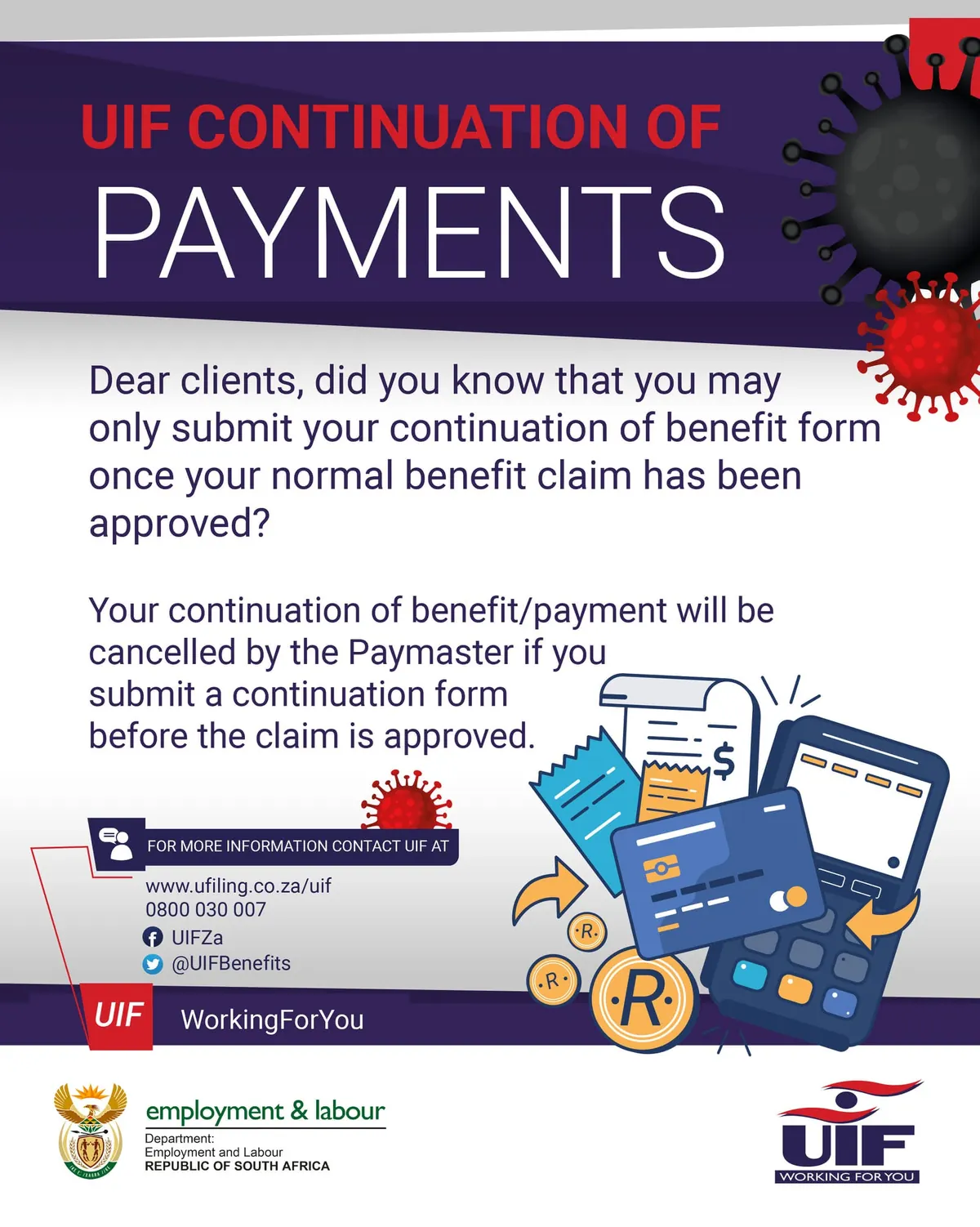
First, your claim is assessed. The Fund checks your documents, your employer's records — above all the UI-19 — and your contribution history. Then, if the claim is approved, the payment side begins: the Fund works out what is payable, confirms the bank account the money will go into, and schedules the payment. Only then is the money transferred to the bank account on your file.
Two points in that chain matter most for anyone waiting:
- Approval and payment are separate steps. An approved claim is not a paid claim. After approval, the Fund still finalises the payment calculation, confirms your bank account and schedules the payment run. That gap is normal, and it is where much of the waiting happens.
- Payments are made in arrears, and they repeat. The Western Cape Government's guide states that once payments start, money is paid every four weeks until the benefits are used up — and that you have to sign the unemployment register every four weeks to show that you still need to claim. Your first payout may therefore cover more than one period, and later payments depend on you keeping up the signing and reporting conditions.
Payments go into the bank account you gave the Fund, on the banking form the bank confirmed. If that account is closed, or the details do not match your identity document exactly, the payment cannot go through — and the Fund will not simply send it somewhere else.
UIF Payment Calculator
Estimate onlyEstimate only, using the same reported method as the payout calculator. Credit days are capped at 365 in a four-year period. The Fund works from your declared earnings history, not the salary you type here.
UIF Payment Waiting Time Guide
GuideFurther payments are generally made periodically, commonly described as every four weeks, for as long as you still qualify and have credit days left — and only if you complete whatever continuation or reporting step the claims officer sets for you.
How to check your UIF payment status
Before you chase a payment, check where it stands. The channel depends on where your claim exists:
- For new claims, start with UIF Online at uifonline.labour.gov.za — the platform where employee benefit claims are now submitted. The Department of Employment and Labour confirmed in a statement dated 24 May 2026 that the UIF is migrating from the legacy uFiling system to UIF Online, that employee claims functionality on the old uFiling platform has already been closed, and that the employer module remains temporarily accessible on the old platform.
- For older claims and contribution history, the uFiling portal at ufiling.labour.gov.za is the system most guides describe. Its dashboard is reported to show your claim history, payment history and available credits.
- By phone, the Department has published a USSD channel for UIF enquiries, reported as *134*843#, whose menu is described as covering claims and payment status.
- By phone or in person, call the UIF call centre on 0800 030 007 with your ID number and reference number ready, or visit your nearest Labour Centre with your ID document.
What you are looking for is the current stage: whether the claim is still being assessed, whether it has been approved and is waiting for payment, whether a payment has been released, or whether a payment attempt failed. Write down exactly what the status says and the date you checked it — you will need both if you have to follow up.
What the common payment stages mean
Status words differ between the portals, and the Fund does not publish a single official glossary that this article could quote. The following are the plain meanings most guides agree on — treat them as a rough map, not as official definitions:
- Pending or in assessment: your claim is still being checked. Documents, employer records or contribution history are still being verified. This is not a rejection.
- Approved: your claim has cleared assessment and is queued for payment. It does not mean the money has left the Fund.
- Payment in progress: your payment request or instruction has been received and is being processed.
- Paid: the funds have been released to the bank account on file. If the money has not reflected in your account after a few working days, check your banking details before anything else.
- Failed payment: the payment attempt did not go through, most often because of incorrect banking details.
If a status word on your screen does not match anything above, do not guess what it means. Ask the call centre or a Labour Centre what that exact status means for your claim.
Why UIF payments are delayed
Most delays have one of a small number of causes. Working through them in order is faster than waiting and hoping.
Your employer's records are missing
The most common cause. If your employer has not submitted the UI-19, or the salary information does not match the Fund's records, the claim cannot be finalised and the payment cannot be scheduled. The Fund cannot pay on the basis of your word alone — it needs the employer's declaration. If your employer is slow, chase the employer in writing, and tell the Fund or your Labour Centre that the UI-19 is outstanding.
Your banking details do not match
The name on the bank account must match your identity document, and the bank must have confirmed the details on the banking form (UI-2.8). Even a small spelling difference can stop a payment. If a payment attempt has failed, this is the first thing to check — and the fix is a corrected, bank-stamped banking form, not a phone call asking for the money to be sent elsewhere.
A document is missing or incorrect
A missing payslip, an unsigned form, a service certificate that was never issued, or a medical certificate that does not cover the period claimed — any of these can hold a claim at the assessment stage. The claim is not refused; it simply does not move until the gap is filled.
You missed a signing or reporting date
For unemployment benefits, the Western Cape Government states that you must sign the register every four weeks. Missing your date can pause payment until you report again. Keep the date you are given, and keep the white card you are issued.
You applied on the wrong platform
Employee benefit claims submitted through the old uFiling claim screens after the migration are no longer processed. If you applied that way, your application may never have entered the system at all. New employee claims go through UIF Online — and if you suspect this happened to you, apply again through UIF Online and tell the Labour Centre what happened.
The system is backlogged
The Fund processes a large volume of claims every month, and the Department has itself acknowledged delays during the migration to UIF Online. A backlog is real, but it is also the explanation people reach for when the actual cause is a missing document. Check your own record first: if everything is complete and correct, a backlog is the more likely story.
How long does a UIF payment take?
There is no single, guaranteed timeline, and this article will not invent one. The honest picture, from official and independent sources together, is this:
- The Western Cape Government's guide says that if everything is in order, you should start receiving money within eight weeks of registering, and that money is then paid every four weeks. That is older guidance, written for the in-person process, and real waiting times vary.
- Independent guides report that complete claims can move from submission to first payment within several weeks, and that the wait stretches to several months when forms are incomplete, employer data is missing, or personal details do not match official records.
- The Fund does not publish a fixed payout date for individual claims.
What that means in practice: if your documents are complete, your employer's records are in, and your banking details match, the wait is usually measured in weeks. If any of those things is wrong, the wait is open-ended until it is fixed — and no amount of checking the portal will move it. Fix the cause, not the calendar.
What to do when your payment has not arrived
Work through these steps in order, and keep a note of what you find at each one:
- Check your payment status on the portal where your claim exists, and write down the exact status and the date.
- Check your bank account — the account on your claim, not another account. Confirm that it is open and that the details on your claim match it exactly.
- Check your documents. Is the UI-19 in? Are your payslips complete? Is your banking form stamped by the bank? If anything is outstanding, submit it now.
- Check your signing dates. If you receive unemployment benefits, confirm that you signed the register when required.
- Contact the UIF. Call the call centre on 0800 030 007 with your ID number and reference number, or visit your nearest Labour Centre with your ID document and the notes from steps 1–4. Ask for the specific reason your payment has not been released — not for a date, but for the reason.
- Fix the specific reason. If it is a missing UI-19, chase your employer in writing. If it is banking details, submit a corrected, bank-stamped form. If it is a missing document, submit it. Then check again after a reasonable interval, and follow up with the same reference number.
If you are told the payment has been released but the money is not in your account after a few working days, ask your bank whether a payment was attempted and returned — a failed payment usually means the account details were wrong.
What not to do while you wait
- Do not pay anyone to speed up your payment. The Fund does not charge for processing or paying claims. Anyone who asks for a fee to release your money is not acting for the Fund.
- Do not share your ID number, passwords or banking details with a website or person offering to check or speed up your payment.
- Do not assume that an "approved" status means the money is on its way today. Approval and payment are separate steps, and the gap between them is normal.
- Do not reapply with the same documents when a claim is stuck. Find the reason first, fix it, and then follow up on the same claim.
- Do not use a lookalike website to check your payment. Use only the official portals, and type the address yourself.
Conclusion
UIF payments follow a chain: assessment, approval, payment calculation, bank verification, and then transfer — and a break anywhere in that chain stops the money. If you are waiting, the most useful thing you can do is find out which link is broken. Check your payment status, check your banking details against your ID, confirm the UI-19 is in, and keep your signing dates. Approval is not payment, and no one can give you a date — but a complete, correct claim with verified banking details is the fastest route to the money arriving.
Frequently asked questions
Tap a question to see the answer.
There is no published, guaranteed time. Guides report that payment can follow within days of a claim being finalised when everything is in order, and that it takes longer — sometimes weeks or months — when employer records, banking details or documents are outstanding. If your claim shows approved but no money has arrived, check your banking details and your payment status, then contact the UIF for the specific reason.
It means your claim cleared assessment and is queued for payment — not that the money has been sent. The Fund still has to finalise the payment calculation, confirm your bank account and schedule the payment. If the wait is long, the usual causes are unverified banking details or a missing employer record. Check both before you follow up.
Most often because the Fund is still waiting on something: your employer's UI-19, banking details that do not match, or a document that was missing or incorrect. Check your claim status, confirm your employer submitted the UI-19, and confirm your banking form was stamped by your bank. A backlog is possible, but a missing document is more common.
Yes. Log in to the official portal where your claim exists — UIF Online for new claims — with your ID number, and look at your claim and payment history. You can also use the Department's published USSD channel, reported as *134*843#, or call the UIF call centre on 0800 030 007 with your ID and reference numbers ready.
A payment the Fund tried to send but could not complete, most often because the bank account details were wrong — the account is closed, or the name does not match your ID. The fix is a corrected banking form confirmed by your bank, not a new application.
The Western Cape Government's guide states that once payments start, money is paid every four weeks until the benefits are used up, provided you keep meeting the conditions — including signing the register every four weeks for unemployment benefits. Your first payout may cover more than one period, because payments are made in arrears.