

UIF Salary Schedule Forms: What They Are and When You Need One
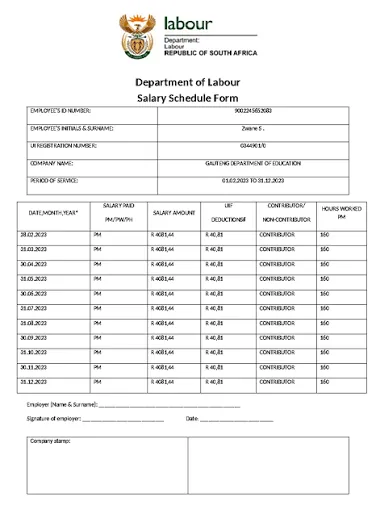
If you are preparing a UIF claim, you may come across the term "salary schedule" — sometimes listed next to the UI-19 as a document your employer must provide. It is easy to misunderstand. A salary schedule is not a form with a number that you download, fill in and submit like the UI-2.1. It is a record your employer produces, showing what you were paid over your employment. And it is not needed for every claim.
This guide explains what a UIF salary schedule is, what it should show, who completes it, when the UIF actually asks for one, and what to do if your employer will not provide it. It also deals directly with the confusion about its form number, because several guides online give it a number that belongs to a different form.
Quick answer: what is a UIF salary schedule?
A UIF salary schedule is a document prepared by your employer that sets out your salary history — the amounts you were paid, and when those amounts changed, over the period of your employment. It is used by the UIF to verify your earnings and contribution history when deciding a claim. It is completed by your employer, usually from payroll records. It is requested in some claims, not all of them, and it is most often asked for when the UIF needs to check earnings that are unclear, incomplete or disputed in the employer's declarations.
UIF Salary Schedule Calculator
ExactA salary schedule records what each employee was paid and what was deducted. The schedule form number is disputed between sources (UI-2.7 vs UI-2.8) — ask for the document by its purpose. Contributions are 1% employee + 1% employer, up to the published earnings ceiling.
What a salary schedule should show
There is no single published template for a salary schedule that was verified in this research pass, so the list below describes what the document is for and what it normally contains, based on how it is described by payroll and UIF guidance. If a Labour Centre or claims officer asks you for one, ask them exactly what they want it to cover — their instruction overrides any general description.
A salary schedule normally shows:
- Your identity and employment details — your name and identity number, your employer's name, and the period of employment the schedule covers.
- Your salary at each stage — the amount you were paid in each period, so that increases, decreases or changes in pay are visible across your employment.
- The dates of any changes — when each salary amount started and ended, so the schedule reads as a history rather than a single figure.
- Consistency with your payslips — the amounts on the schedule should match the amounts on your payslips for the same periods, because the schedule is used to cross-check them.
The point of the document is verification. The UIF already holds your employer's declarations. The salary schedule lets the claims officer compare what the employer declared with what was actually paid, month by month, and resolve any difference between the two.
Salary schedule vs UI-19 vs UI-2.7: how they differ
These three documents are often confused because they all come from the employer and they all relate to your pay. They are different documents with different jobs.
| Document | Who completes it | What it shows | When it is used |
|---|---|---|---|
| UI-19 | Your employer | Declaration of employees: identity numbers, pay, hours, start and end dates, and the reason employment ended; also the monthly declaration | Every claim, and monthly by the employer |
| UI-2.7 | Your employer | Record of remuneration received while you were employed | Supporting a claim, alongside the UI-19 |
| Salary schedule | Your employer, from payroll records | Your salary history and changes over your employment | When the UIF asks for it, usually to verify earnings or resolve conflicting records |
| Payslips | Your employer (issued to you) | What you were actually paid in each pay period | Evidence you hold yourself; used to cross-check the schedule and the UI-19 |
The simplest way to remember the difference: the UI-19 says you worked there and why you left; the UI-2.7 records what you were paid while employed; the salary schedule shows how your pay changed over time; your payslips are your own copies of the same story. If the four agree with each other, the earnings side of a claim is straightforward. If they disagree, the salary schedule is often the document the UIF asks for to settle the difference.
The form-number problem: this document has no number you should trust
This is the most important warning in this article. Some guides online call the salary schedule "UI-2.8". Other guides say UI-2.8 is the banking-authorisation form, and that UI-2.7 is the employer salary declaration. Both cannot be right, and the second reading is the one supported by the form texts: the UI-2.1 application form asks whether your employer has completed a UI-2.7, in the context of remuneration, and the more careful guides describe UI-2.8 as the banking details form.
The honest position, on the evidence available in this pass, is this:
- Do not treat the salary schedule as a numbered form. It is described in reliable payroll guidance as a schedule or record produced by the employer, not as a UI-numbered form.
- Do not write "UI-2.8" on a salary schedule, and do not ask your employer for a "UI-2.8 salary schedule". That number belongs, on the best evidence, to the banking details form. Asking for it by the wrong number is how claims get delayed.
- Ask for it by its purpose. "A salary schedule showing my salary history and changes from the start of my employment" is a request any payroll department understands, and it avoids the number entirely.
- If a Labour Centre or claims officer gives you a form number for it, follow their instruction — they are working from the current official forms, and their word overrides this guide.
This conflict is recorded as the main verification flag in Section 5. No form number for the salary schedule is stated as a fact anywhere in this article, and none should be added until it is verified on an official source.
When does the UIF ask for a salary schedule?
A salary schedule is not a routine requirement for every UIF claim. Payroll guidance states this directly: salary schedules are not a requirement for UIF claims in general, but the Department may request one where it has concerns about conflicting or missing information. In practice, that means you are most likely to be asked for one when:
- Employer declarations are missing or incomplete. If the UIF cannot see a complete declaration history for you, a salary schedule helps fill the gap.
- Records conflict. If the employer's declaration, your payslips and your application do not agree about what you earned, the schedule is used to establish the correct figures.
- Your pay changed during your employment. A single final salary figure does not show a history of increases or reductions. The schedule shows the whole picture, which matters for maternity claims and other claims where earnings over a period are relevant.
- A benefit depends on earnings over time. Maternity claims are the example most often mentioned in guides: the employer is expected to supply the UI-19, a salary declaration and a salary schedule together, because the benefit relates to earnings across the employment period.
If you are not asked for one, do not delay your claim to obtain one. Submit the core forms — the application form, the UI-19, the UI-2.7 and the banking form — and provide the salary schedule if and when it is requested.
Who completes the salary schedule, and how to get one
The salary schedule is completed by your employer, from payroll records. In practice that usually means the employer's payroll department, payroll provider or accountant. You do not complete it yourself, and you should not invent or estimate the figures on it.
To get one:
- Ask your employer in writing. Ask for a salary schedule showing your salary history and any changes, from the start of your employment to your last day. Put the request in writing — email is fine — and keep a copy. Note the date you asked.
- Say why you need it. "The UIF has asked for a salary schedule to verify my earnings for my claim" is clearer than "I need a form", and it helps payroll prioritise the request.
- Check it when you receive it. Compare the amounts and dates against your payslips. If a period is missing or an amount does not match a payslip, ask payroll to correct it before you submit it. Submitting a schedule that contradicts your own payslips creates the very problem the schedule is meant to solve.
- Keep a copy. Keep a copy of the schedule and of your written request, with everything else in your claim file.
What if your employer will not provide one, or no longer exists?
Do not let a missing salary schedule stop your claim. Gather the evidence you do have — your payslips, your contract or appointment letter, bank statements showing salary payments, and the UI-19 if you have it — and take them to a Labour Centre. Explain that the employer cannot or will not provide a schedule. The Labour Centre can advise what alternative evidence to submit, and the Department can follow up with the employer. The same applies if the business has closed: your own records become the evidence, and the Labour Centre is the place to present them.
What to check before you submit a salary schedule
- Every period of your employment is covered, with no unexplained gaps.
- The salary amounts match your payslips for the same periods.
- The dates of salary changes are shown, not just the final salary.
- Your name and identity number on the schedule match your ID.
- The employer's details on the schedule match the employer named on your UI-19.
- You have kept a copy.
One caution: a schedule is only as good as the payroll records behind it. If your payslips show UIF deductions but the employer's records do not show corresponding contributions, that is a different problem — missing contributions — and it should be raised with the Labour Centre rather than papered over with a corrected schedule. Do not alter a schedule yourself to make the figures match; if figures are wrong, ask the employer to correct and reissue it.
How the salary schedule fits into the online claim process
Employee benefit claims are now made on UIF Online, at uifonline.labour.gov.za, following the closure of the legacy uFiling employee claims portal on 20 May 2026. uFiling remains the system for employer declarations and contributions. A salary schedule is a supporting document, not an online form: you obtain it from your employer and submit it as part of your claim, either by uploading it through the online process where the portal asks for supporting documents, or in person at a Labour Centre. If the portal does not ask for a salary schedule, do not assume it is not needed — a claims officer may still request it later, and it is worth having it ready.
Conclusion
A UIF salary schedule is a simple idea wrapped in confusing terminology. It is your employer's record of what you were paid and when that pay changed — a document for verifying earnings, not a numbered form to download. You need one only when the UIF asks for it, most often when declarations are missing or records conflict. When you do need one, ask your employer for it by its purpose, check it against your payslips, and keep a copy. And if anyone quotes you a form number for it, be cautious: the numbers circulating online conflict, and the only safe instruction is the one from the UIF itself or a Labour Centre.
Frequently asked questions
Tap a question to see the answer.
No. Payroll guidance states that salary schedules are not a requirement for UIF claims in general. The Department may request one where it has concerns about conflicting or missing information, or where earnings over a period need to be verified. Submit the core claim forms first, and provide a schedule if it is requested.
There is no form number for the salary schedule that could be verified as a fact in this pass. Some guides call it UI-2.8, but the better-supported reading is that UI-2.8 is the banking details form and UI-2.7 is the remuneration record. Ask for the document by its purpose — a schedule of your salary history — rather than by a number.
The UI-19 is the employer's declaration of employees: who worked there, what they were paid, their hours, and why the employment ended. It is used for monthly declarations as well as for claims. A salary schedule is a history of your pay and how it changed over your employment, used to verify earnings. A claim normally needs the UI-19; a salary schedule is an additional document requested when earnings need closer verification.
Payslips are strong evidence of what you were paid, and they are the first thing to use if a schedule cannot be obtained. Whether they can fully replace a schedule depends on what the claims officer has asked for and what periods they need to verify. If you are asked for a schedule and cannot get one, take your payslips to a Labour Centre and ask whether they are sufficient in your case.
Ask in writing and keep a copy of the request. If the employer still refuses, or the business has closed, take your payslips, contract, bank statements showing salary payments and any UI-19 you have to a Labour Centre. The Department can follow up with the employer, and the Labour Centre can advise what alternative evidence to submit.
That depends on what the UIF has asked for. Older guidance suggests the UIF looks at several years of work history when calculating a benefit, but the exact period has not been verified against a current official source in this pass, so no number of years is stated here as a fact. If you are asked for a schedule, ask the claims officer or the Labour Centre which period it should cover, and ask your employer for that period. The question is recorded as a flag in Section 5.